Insights
EVA vs PE vs XPE vs PU Foam Inserts: Choose by Load Path, Contact Surface, and Moisture
Choose PE for a firm economical closed-cell base, XPE for a finer routed surface, EVA for presentation and repeated handling, and PU for softer lid contact—many flight-case interiors mix grades by load path and contact surface rather than using one foam for every job.
Quick Answer
Choose PE when a firm, economical closed-cell base must hold shape under heavier items; choose XPE when a finer routed surface and dimensional feel matter for precision parts; choose EVA when you need a firm closed-cell insert with clean presentation and repeated handling; choose PU when softer cushioning or lid contact is the priority. Many custom flight-case interiors combine grades—for example a firm PE base with an EVA or XPE facing—rather than forcing one foam to do every job (custom foam inserts; FAQ).
A single soft foam can crush under dense equipment; a single hard foam can mark delicate finishes. Mixed-density builds put weight on a firm base and use a gentler facing or lid foam at the contact surface. Separate cavities keep calibrated or battery items from touching in transit.
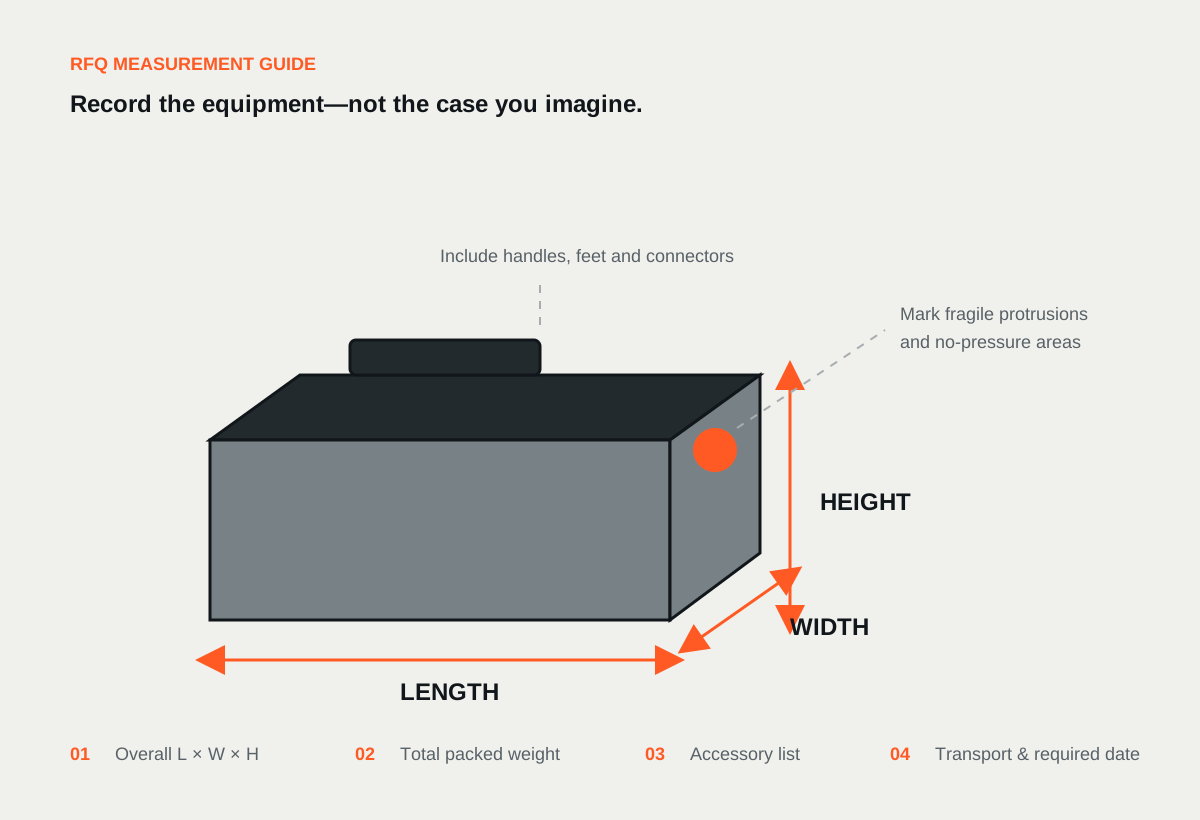
Send case internal dimensions (or confirm the case will be built with the insert), equipment outlines including protrusions, which items are heavy vs surface-sensitive, transport environment (including humidity / sea freight if relevant), and any true special requirement with a named grade (ESD, flame, chemical). A preference like “EVA” helps, but load and contact surface should drive the recommendation.
Four foam families in plain language
Cangzhou Fuhong machines custom inserts in EVA, PE, XPE, and PU. Density, thickness, and structure follow the equipment—not a one-size catalog SKU (FAQ; custom foam inserts). The blurbs below are selection language aligned with the live foam hub; they are not density tables or certification claims.
PE
PE is typically the firmest and most economical closed-cell option for flight-case work. It suits heavy items, base layers, and builds that must hold shape under load. Lightweight closed-cell PE is common for general transport when presentation is secondary to support and cost (custom foam inserts; ordering notes PE as the most economical grade among common choices).
XPE
XPE is closed-cell with a finer cell structure than standard PE, which yields a smoother routed surface. It is a practical choice when precision feel and tighter visual/dimensional presentation of cavities matter. Moisture-resistant grades can be discussed when the project requires them—always as a selected grade, not as a family-name promise (custom foam inserts; FAQ).
EVA
EVA is the most common choice for tools, instruments, and electronics interiors that need a firm closed-cell feel, clean finish, and detailed routing for presentation and repeated handling. Softer facings can be laminated when contact needs a gentler surface over a firm core (custom foam inserts; FAQ).
PU
PU prioritizes softer contact and cushioning—often lids and lining—where rebound and impact feel matter more than a hard nest. Open- or closed-cell behaviour depends on the selected grade; do not assume every PU sheet is closed-cell for sea freight (custom foam inserts; FAQ).
Decision tree
Work the grade question in this order—then let the factory propose from the equipment description (FAQ):
- Load path / weight — What must carry the mass without crushing? Start with firm PE (or a firm EVA/XPE structure) as the base when items are heavy or dense.
- Contact surface — Will finishes scratch, optics mark, or housings need a gentler face? Add EVA/XPE facing or PU lid/lining where contact softness matters.
- Moisture / reuse / wipe-down — Prefer closed-cell for transport and damp-cloth cleaning. Open-cell soft cushioning is for light loads where moisture is not the driver (custom foam inserts).
- Presentation / repeated handling — Detailed routing and a clean show face often point to EVA (or XPE when a finer routed surface is wanted).
- Special claims — ESD, flame, chemical, or temperature claims only against a selected material and agreed requirements—not against the family name alone (FAQ; custom foam inserts).
Application context can refine the tree without rewriting product pages: precision instruments often favour detailed routing and careful contact (precision instrument cases); UAV kits often need separated cavities (drone / UAV cases); medical equipment projects care about cleanability framing without over-claiming certification (medical equipment cases); touring AV work stresses repeated handling (AV rack cases).
Mixed-density builds that solve real failures
Mixed-density builds are normal OEM practice: firm base + soft facing + rigid support where needed (custom foam inserts). Typical patterns:
| Failure mode | Mixed-density answer (conceptual) |
|---|---|
| Soft foam crushes under dense gear | Firm PE (or firm EVA) base carries weight |
| Hard foam marks delicate finishes | Softer facing or PU lid at contact surface |
| Items collide in shared cavity | One item, one position; separate nests for batteries / calibrated parts |
| Lid bounce damages optics | Softer lid lining with firm base nest |
Design rules that travel with any grade: route cavities rather than knife-cut improvisation; put weight on a firm base; include finger reliefs; keep the insert liftable; match material to contact (custom foam inserts). Colors (black, orange, blue, military green, custom red) and options such as flocked facing, surface lamination, laser marking/hot stamp, or heat forming are available when specified—not as a stocked catalogue promise (custom foam inserts).
Closed-cell, cleaning, and sea freight
Closed-cell foam is the default transport choice because it resists water better than open-cell cushioning (custom foam inserts). For humidity and sea-freight thinking:
- Prefer closed-cell families/grades for nests that may see condensation or damp packing environments.
- Wipe closed-cell surfaces with a damp cloth; solvents can degrade foam.
- Medical wipe-down is not device certification. Cleanability language for transport inserts is not the same as sterilizable / medical-device claims. Waterproof or military-grade performance is not automatic—it depends on configuration and any agreed test method (FAQ; custom foam inserts; medical equipment cases).
Do not invent density numbers or “always waterproof foam” claims from a family name.
Special claims need a specified grade
ESD, flame, chemical, and temperature requirements only hold against selected material data and agreed project requirements (FAQ; custom foam inserts; factory & quality). Practical buyer hygiene:
- Name the requirement and, when known, the grade or standard you need tested against.
- Agree method, sample, acceptance, schedule, and cost before treating third-party testing as in-scope (FAQ).
- Do not accept “ESD foam” or “flame-proof” as a verbal family label without a named grade on the drawing/BOM.
Silent substitution of foam grade after approval is not acceptable process; component changes should be confirmed first (factory & quality).
RFQ foam line checklist
Treat the foam line as part of the case RFQ—not a colour preference alone. Useful inputs (custom foam inserts; RFQ checklist):
| Include | Why |
|---|---|
| Case internal dimensions (or “build case with insert”) | Insert is sized to internals |
| Equipment dims including protrusions | Cavity depth and clearance |
| Heavy vs surface-sensitive items | Drives base vs facing grade |
| Removal / access requirements | Finger reliefs, liftable insert |
| Moisture / sea freight / wipe-down needs | Closed-cell vs open-cell caution |
| Preferred family if any (or “propose”) | Factory can propose from description |
| Special claims with named grade if any | ESD / flame / chemical only when specified |
| Quantity path (sample insert → reorder) | Paid sample inserts often first (FAQ) |
Photos can start the conversation; tight tolerances need dimensions or a drawing (FAQ). Drawing and change control: engineering support. For first-unit / paid-prototype commercial workflow, see custom flight case MOQ 1 & paid prototype.
Method note: CNC vs die-cut is a separate decision
This page chooses foam family and layering. Fabrication method—CNC routing versus die-cut—is a separate decision about volume, cavity complexity, and change control. When published, see CNC foam insert vs die-cut for flight cases for that comparison; do not treat this selection guide as a machining encyclopedia. Commercial CNC foam inserts for custom flight cases remain the primary path on the custom foam inserts hub and companion custom flight cases builds.
FAQ
Q1. EVA vs PE vs XPE vs PU — which foam insert should buyers choose?
Choose PE for a firm, economical closed-cell base under heavier items; XPE for a finer routed surface and precision feel; EVA for firm closed-cell presentation and repeated handling; PU when softer cushioning or lid contact is the priority. Many interiors mix grades rather than forcing one foam to do every job (custom foam inserts; FAQ).
Q2. Why do flight-case inserts often use more than one foam?
Soft foam can crush under dense equipment; hard foam can mark delicate finishes. Mixed-density builds put weight on a firm base and use a gentler facing or lid foam at contact. Separate cavities keep calibrated or battery items from touching in transit.
Q3. What should buyers send so a factory can propose a foam grade?
Case internal dimensions (or confirm the case will be built with the insert), equipment outlines including protrusions, heavy vs surface-sensitive items, transport environment (humidity/sea freight if relevant), and any special requirement with a named grade. Preference language helps; load and contact surface should drive the recommendation.
Q4. Does closed-cell mean medical-sterilizable or waterproof-certified?
No. Closed-cell helps transport and damp-cloth wipe-down. Wipe-down is not device certification; waterproof/military-grade claims depend on configuration and agreed test methods (FAQ; custom foam inserts).
Q5. Can we order a paid foam sample before the full case?
Yes. Paid sample inserts are often confirmed first; the case is specified once the insert is confirmed (FAQ). Sample commercial practice (paid in advance; credit against first production order when a sample leads to that order) is summarised on ordering—confirm in the quotation.
Q6. How do we verify the factory can CNC the interior we need?
Ask for the manufacturing split, drawing control, and—when useful—workshop video / PSI scope for foam fit. See verify a China flight case factory and factory & quality.
Closing CTA
Describe the equipment weight, fragile surfaces, and case internal size—we will propose EVA / PE / XPE / PU (or a mixed build) and CNC-route a layout. Start at custom foam inserts, or contact with outlines, quantity path, and any named special-grade requirements.