Insights
Flat-Pack Flight Case Kits for Overseas Assemblers: When Kits Beat Finished Cases
Flat-pack flight case kits usually beat finished cases when freight volume drives landed cost, the receiving team can assemble to drawing, and a paid trial kit can confirm the BOM before reorders.
Quick Answer
A flat pack flight case kit is a B2B supply model: pre-cut plywood panels, cut aluminum profiles and corners, purchased hardware and fasteners, plus machined foam when in scope—packed to one approved drawing and bill of materials (BOM) for local assembly by a team that already knows flight-case work.
Kits usually win when freight volume (not weight) drives landed cost, the receiving team has tools for dimensions, riveting, alignment and final inspection, and you can approve a paid trial kit before reorders. Kits are the wrong answer for tight interior geometry, buyers without assembly capability, certification-as-a-unit projects, low-volume distant assembly where local labour and risk erase the freight benefit, or urgent deadlines that cannot absorb an extra destination assembly stage.
Does flat-pack always reduce total cost? No. Assembly labour, tooling, packing density, damage risk and local quality control also matter—compare those factors before you quote or buy. Start from the finished case drawing, then decide kit vs finished case vs foam-only; route the RFQ through the flat-pack case kits hub when kit supply looks right.
What “flat-pack kit” means in B2B (not a DIY hobby box)
In industrial supply, a flat pack flight case kit is not a consumer “assemble at home” box. It is a knock down flight case OEM package for case makers, distributors and production teams that already understand flight-case assembly. The supplier prepares components to an approved finished-case drawing; the local assembler owns squareness, fastening, seal alignment, hardware operation and finished-case inspection—agreed before ordering.
Cangzhou Fuhong’s factory handles panel cutting, CNC foam, fabrication, assembly and inspection in-house, and purchases panels, profiles, hardware and foam to spec (FAQ). Kit supply follows the same discipline: one coordinated build, not unmatched parts.
Panels, profiles, hardware, fasteners
A complete kit typically ships as:
- Pre-cut plywood flight case panels — cut to the approved case dimensions, ready for assembly at destination.
- Aluminum profiles and corner sections — edge and corner extrusions cut to length and matched to the panel set.
- Purchased hardware — handles, latches, corners, hinges, fasteners and casters selected to the approved BOM.
- Fasteners and hole positions — confirmed in the project documents so nothing arrives orphaned.
Parts can be grouped by case or by assembly stage. Protective packing and export-carton requirements depend on quantity, component finish and transport route (flat-pack kits).
Machined foam when in scope
When the project includes interior protection, machined foam ships in the same kit: cavities are routed before shipping so the destination only assembles. Foam is scoped, not assumed. For foam-only or insert-first work, see custom foam inserts. A flight case components kit with foam follows the same approved drawing as the shell parts.
What kit supply excludes (per the product page): assembly labour (quoted separately if wanted); consumer-style manuals (agreed reference information only); a guarantee of the assembled result (part accuracy is the supplier’s; finished build depends on assembly); and freight/duties (quoted per trade term—flattening reduces volume, it does not remove shipment cost).
When kits usually win
Kits tend to beat finished cases when several conditions line up:
- Volume-driven freight — Assembled cases ship mostly as air volume. Flattening puts more units in the same container. The saving is volume, not weight—qualitative only; not a fixed percentage (flat-pack kits).
- Capable receiving team — Case makers, distributors or production teams that already control dimensions, riveting, alignment and final inspection.
- Repeatable BOM — One approved drawing; pack per case so reorders stay stable.
- Trial before scale — MOQ can start from one piece. A paid trial flat-pack kit confirms drawing, fit and assembly sequence before repeats (flat-pack kits; FAQ).
- Clear scope split — Draw the finished case first, then split into panels, profiles, hardware and optional foam—see the custom flight case RFQ checklist.
Customs note (qualitative / process only): components and finished goods may classify differently—check with your broker before volume commitments (flat-pack kits).
When kits are the wrong answer
Flat-pack is project-specific. Kit supply is the wrong answer when:
- Low volume, distant assembly — Freight saving may not cover local assembly cost and extra handling risk.
- Tight interior geometry / tolerance — Destination assembly variation can cost more than the freight saved.
- Buyer without assembly capability — If the recipient cannot build correctly without further cutting, a finished case is often cheaper in total.
- Certification-as-a-unit — Kit supply complicates inspection or certification of the finished item as a unit.
- Urgent deadlines — A kit adds a destination assembly stage; when time is tight, that stage belongs in the factory.
Lower shipment volume may help, but assembly labour, tooling, packing density, damage risk and local QC must still be weighed before quotation (flat-pack kits). When finished supply is the better call, use custom flight cases.
What to put in a kit RFQ
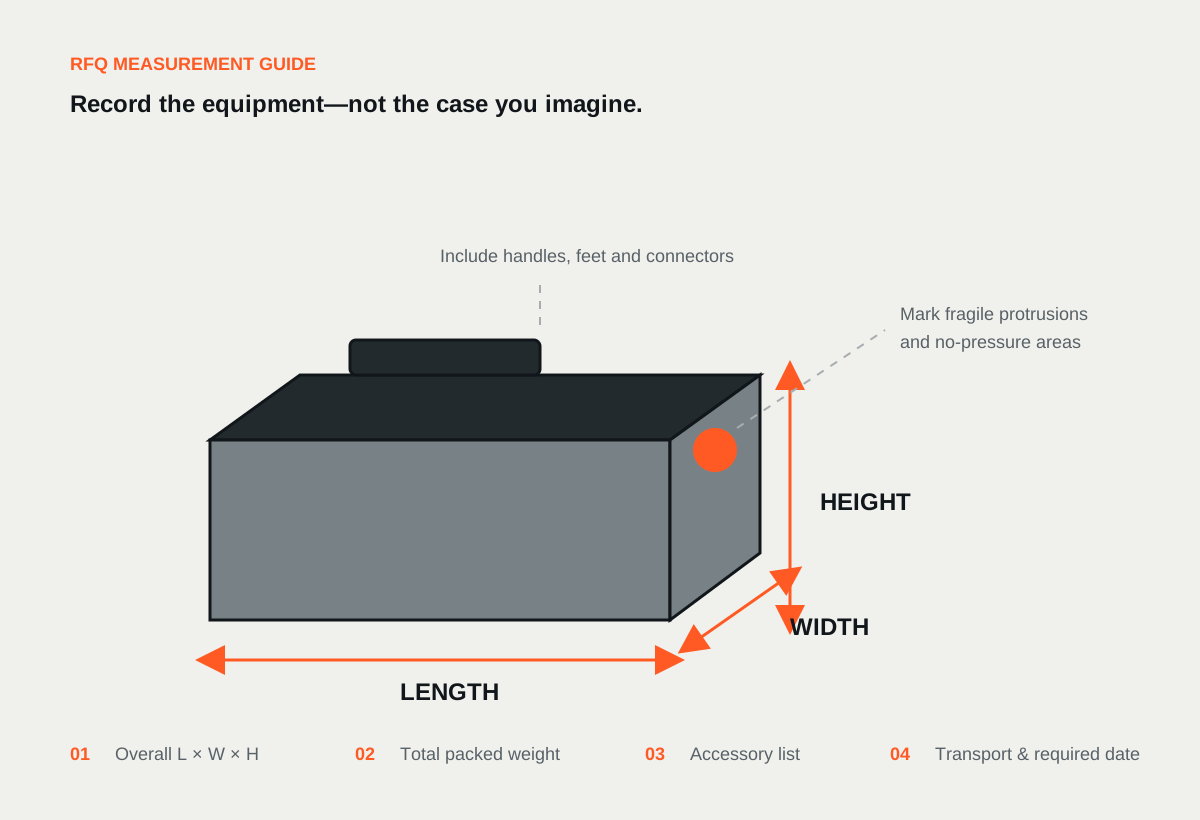
Treat the RFQ as a finished-case specification that will be split into parts—not a loose shopping list. Useful inputs:
| Include | Why it matters |
|---|---|
| Finished exterior / interior dimensions, openings, access | Starting point is always the assembled product |
| Panel construction intent (thickness / laminate direction if known) | Drives pre-cut panel set |
| Hardware list or preferred brands/models | Handles, latches, corners, hinges, casters, fasteners |
| Foam in scope? Yes / no + equipment footprint | Machined foam only when scoped |
| Quantity path: trial kit qty → expected reorder | MOQ from 1; trial informs BOM |
| Receiving assembly capability (tools, QC) | Supplier reviews suitability before confirming kit supply |
| Packing preference (by case vs by stage) + destination / trade term | Packing depends on design, qty, shipping economics |
| Any certification-as-unit or tight-tolerance notes | May push you to finished case instead |
Photos can start the conversation; tight tolerances need dimensions or a drawing (FAQ). For drawing conventions and the approval loop, see engineering support. Commercial windows and payment practice are summarised on ordering.
Trial kit → approved BOM → reorder
A practical path for overseas assemblers:
- Draw the finished case — Dimensions, construction, hardware positions, internal layout.
- Split into parts — Panels and profiles cut to dimension; joints and hardware defined.
- Machine the foam (when in scope) — Cavities routed before shipping.
- Pack as one kit — All parts for one case together so nothing arrives orphaned.
- Paid trial kit — Confirm drawing, fit and assembly sequence with the receiving team.
- Approve BOM / drawing revision — Amendments are issued as a new revision for approval (FAQ).
- Reorder from the approved set — Repeat orders run from the approved drawing, which removes the design and setup share from unit pricing relative to a first custom build (commercial practice described on site, not a price guarantee).
Commercial practice (not guarantees): Prototypes/samples are paid in advance. Where a sample leads to a production order, site practice credits sample cost against that first order (ordering). Production payment is typically 30/70 T/T; samples paid in advance.
Planning lead windows (not guarantees; committed schedule in the quotation): FAQ early planning ≈1–3 wd requirement review, 2–5 drawing, 7–15 optional paid prototype, 15–30 production after approval. After drawing approval + deposit (ordering): flat-pack kits typically 10–18 wd; finished custom flight cases 15–25 wd; CNC foam inserts 7–12 wd. Prototypes are often outside the normal queue. Clock starts at approval and deposit, not enquiry.
Inspection stages: factory & quality.
Kit vs finished case vs foam-only
| Model | What you receive | Who finishes the build | Typical when |
|---|---|---|---|
| Flat-pack kit | Pre-cut panels, profiles, hardware, fasteners; machined foam if scoped | Local assembler | Capable team + volume/freight logic + trial BOM |
| Finished custom flight case | Assembled, inspected case | Supplier factory | No local assembly capability; tight geometry; certification-as-unit; urgent deadline |
| Foam-only / inserts | Machined inserts (case may follow later) | N/A for shell | Insert fit first; existing shell; foam scope only |
Use kits when the team can assemble to drawing and freight volume dominates. Use finished cases when destination variation, certification or schedule risk outweighs packing density. Use foam-only when the interior is the open question—or the shell already exists. Route decisions via the flat-pack hub, custom flight cases and custom foam inserts.
FAQ
What is a flat pack flight case kit in B2B terms?
Pre-cut plywood panels, cut aluminum profiles/corners, purchased hardware and fasteners, plus machined foam when in scope—supplied as one coordinated kit to an approved drawing/BOM for local assembly by a capable team—not a consumer DIY box (flat-pack kits).
Does flat-pack always reduce total cost?
No. Lower shipment volume may help (volume, not weight—qualitative), but assembly labour, tooling, packing density, damage risk and local QC must also be considered before quotation.
Who should order knock-down / kit supply?
Case makers, distributors or production teams that already understand flight-case assembly and have tools for dimensions, riveting, alignment and final inspection. Capability is reviewed before kit supply is confirmed.
Can we start with one trial flat-pack kit?
Yes. MOQ can start from one piece. A paid trial kit confirms drawing, fit and assembly sequence before repeats. Samples are paid; site practice credits sample cost against the first production order when a sample leads to that order—confirm in the quotation (ordering; FAQ).
What lead time should we plan for kits vs finished cases vs foam?
Planning ranges after drawing approval (committed dates in the quotation): kits ≈10–18 wd; finished cases ≈15–25; CNC foam ≈7–12. Prototypes often outside the normal queue (ordering).
Do kits include a consumer assembly manual or a finished-build guarantee?
No. Kits ship with agreed reference information, not a consumer manual. Part accuracy is the supplier’s; finished-build accuracy depends on local assembly. Agree receiving QC before ordering.
Next step
If your team can assemble to drawing, send finished-case dimensions and whether you need machined foam in the kit—we can review kit vs finished supply and, when useful, a paid trial kit. Start at the flat-pack flight case kits hub, or contact with your drawing, quantity path and assembly capability notes.