Insights
CNC Foam Insert vs Die-Cut Foam for Flight Cases: Which Method Fits Your RFQ?
CNC routing supports multi-depth cavities, prototypes and changing layouts without steel-rule tooling. Die-cutting suits frozen, mostly single-level cavity plans at volume once tooling is justified.
Quick Answer
CNC-routed foam and die-cut foam are two industrial ways to create cavities in case inserts—not interchangeable defaults. CNC routes cavities from dimensions or a drawing, often with multiple depths and undercuts in one block, so prototypes, changing layouts and custom flight-case interiors can start without steel-rule tooling. Die-cutting presses a steel-rule die through foam sheet; it suits frozen, mostly single-level cavity plans at volume once tooling is justified.
For custom flight cases, the practical default is often CNC first: MOQ from one piece, paid physical prototypes confirm fit, and reorders run from the approved drawing and foam grade (custom foam inserts; FAQ). Die-cutting remains a fair industry option when the drawing is frozen, cavities are largely planar, and quantity amortises die make. Cangzhou Fuhong’s published commercial path for custom interiors is CNC machining/routing of EVA, PE, XPE and PU—not an in-house steel-rule die-press claim.
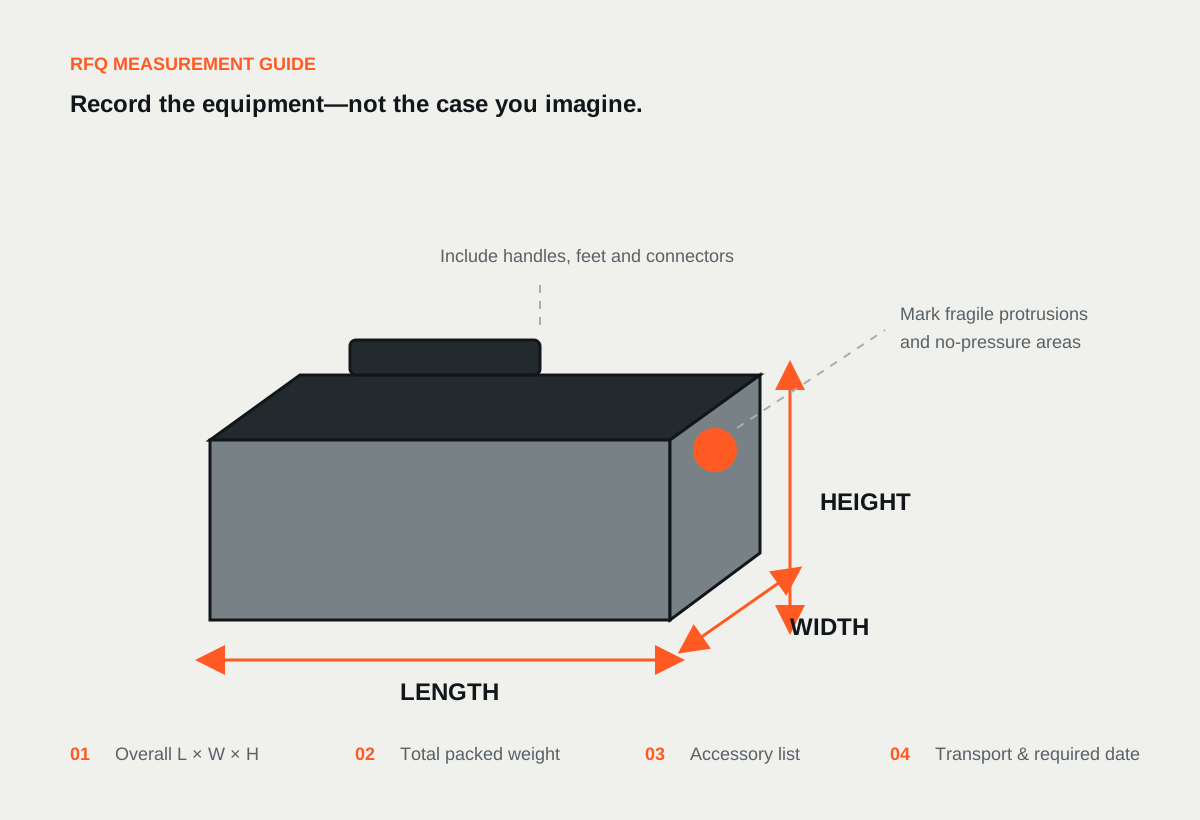
Difference in one line: CNC changes with a drawing revision; die-cut changes usually mean a new or modified die. Specify CNC when geometry is multi-depth, drawings may still move, or you need a prototype before volume. Send case internal dimensions, equipment outlines with protrusions, removal/access notes, material preference if any, and the quantity path (sample → reorder)—photos start; tight fits need dims or a drawing (custom foam inserts; FAQ).
What CNC-routed and die-cut mean
Both methods remove foam to leave nests. The difference is how the cavity is made—and what that implies for tooling, change control and geometry.
Die-cutting (steel-rule)
In industry practice, a steel-rule die is built to the cavity outline and pressed through foam sheet. Strengths: once the die is proven and the layout is frozen, repeats can be fast for flat or lightly contoured nests. Limits: multi-depth pockets, undercuts and frequent drawing changes are awkward; tooling sits in front of the first good unit; a geometry change often needs die rework or a new die. This article explains die-cutting fairly as an industry method. It does not claim Fuhong operates in-house steel-rule die-press capacity.
CNC routing
CNC foam machining routes cavities from dimensions or drawings. On Fuhong’s custom foam inserts path, that includes multiple depths and undercuts in one block, mixed-density builds, and flocked facing when specified. Design rules: cavities are routed, not knife-cut improvisation; one item, one position; weight on a firm base; finger reliefs; liftable insert; material matched to contact. In-house work on the FAQ and factory & quality pages includes panel cutting, CNC foam machining, fabrication, assembly and inspection; panels, profiles, hardware and foam are purchased to the approved specification.
Four facts that decide: geometry, thickness/wall quality, drawing freeze, quantity/reorder
Score the project on four facts before locking a method into the RFQ:
- Geometry — Single-level outlines favour die discussion. Multi-depth nests, undercuts, accessory pockets and layered stacks favour CNC (custom foam inserts).
- Thickness and wall quality — Tall walls, thin partitions and clean vertical faces are machining questions. Die behaviour through thick or laminated stacks is project-specific; this draft invents no universal thickness limit.
- Drawing freeze — If the equipment list or access plan may still change after the first sample, CNC revisions are usually cheaper than retooling a die. Amendments after approval are issued as a new drawing revision (FAQ; engineering support).
- Quantity and reorder path — MOQ from 1 and paid prototypes support CNC-led custom work (FAQ). Die tooling pays off when the layout is frozen and volume justifies the die. Reorders from an approved drawing/grade remove the design and setup share relative to a first custom build (commercial practice—not a price guarantee) (ordering).
Material family (EVA / PE / XPE / PU) is a separate decision—see the EVA vs PE vs XPE vs PU foam insert guide. Method chooses how cavities are made; grade chooses load path and contact surface.
Side-by-side comparison
Qualitative only—no invented ±tolerances, break-even unit counts or prices.
| Factor | CNC-routed foam | Die-cut foam (industry) |
|---|---|---|
| Tooling | Program / fixture from drawing; no steel-rule die for the cavity set | Steel-rule die (and press setup) before volume |
| Design change | New revision / re-route | Often die rework or new die |
| Multi-depth / undercut | Common on CNC path (one block) | Awkward; may need layered dies + laminate or another process |
| Cycle time (after setup) | Machine time per nest set | Press cycle can be fast once die is proven |
| Typical stage | Prototype → custom → reorder from drawing | Frozen flat layout at volume |
| Risk if wrong | Extra routing revisions if requirements were vague | A die that does not match the final nest |
Treat CNC as Fuhong’s published custom-interior path (custom foam inserts). Mention die-cut only when your volume programme truly needs that industry route.
When CNC is the right default for custom flight cases
CNC is usually the right default when the case is custom and the interior must follow equipment state; when you need multi-depth cavities, undercuts or mixed-density layers; when MOQ from 1 and a paid physical prototype matter (FAQ; custom flight case MOQ 1 & paid prototype); when drawings may still move; and when reorders must lock to an approved drawing and foam grade (custom foam inserts). Context that often stays on CNC: precision instrument cases and drone / UAV cases.
When die-cutting earns its tooling
Die-cutting earns its tooling in industry programmes when the cavity plan is frozen and largely single-level, and quantity is high enough that die make beats repeating machine time (judge per project—no invented break-even count). Wall quality at that thickness must still suit the equipment.
Layered die + laminate is sometimes discussed as a volume path for multi-level looks: cut layers separately and bond them. That is an industry fabrication discussion, not a Fuhong in-house die-press claim. If you need that path, say so in the RFQ and ask which process the quoting plant will use. For Fuhong custom interiors, start from CNC routing on the custom foam inserts hub.
Flight-case failure modes the method must prevent
Method choice does not excuse bad nest design. The same failure modes kill protection whether the cavity was routed or die-cut:
- Shared cavities — Items that share a nest touch in transit; contact between finished or calibrated parts starts damage (custom foam inserts).
- No finger relief — Operators pull on shafts, faces or connectors instead of housings.
- Soft foam carrying weight — Dense items need a firm base; the facing locates, it does not carry mass.
- Insert sized to a photo, not case internals — Internal dimensions are the measurement most often missing; photos start, tight fits need dims or a drawing (custom foam inserts; FAQ).
CNC vs die-cut decides repeatability and change cost; design rules decide whether the gear survives the trip.
How overseas buyers write the foam method line in RFQ
Treat method as one line inside a full foam/case RFQ—not a slogan:
| RFQ line | Example intent |
|---|---|
| Method preference | “CNC-routed preferred; open to recommendation after geometry and qty path review.” |
| Geometry / freeze | Multi-depth / undercut / single-level; drawing may change vs frozen for volume |
| Case internals + equipment | Inside L×W×H; outlines + protrusions |
| Access / material / qty | Lift-out and finger reliefs; grade preference or “propose”; sample → reorder |
Full checklist: custom flight case RFQ checklist. Drawing conventions: engineering support. Remote factory checks: verify a China flight case factory.
Paid prototype → approved drawing → reorder
A practical CNC-led path:
- Enquiry — Photos can start; include internals and equipment dims when known (FAQ).
- Quote inputs — Case internal dims, equipment dims + protrusions, removal, material preference, quantity path (custom foam inserts).
- Drawing — Dimensions, foam layout and materials confirmed before cutting.
- Paid prototype / sample insert — Physical prototypes are paid; sample inserts are often confirmed before the case is locked (FAQ).
- Approve revision — Changes after approval are a new revision (FAQ).
- Production / reorder — Reorders from the approved drawing and grade; design/setup share drops relative to first custom build (commercial practice—confirm in quotation) (ordering).
Commercial practice (not guarantees): Samples/prototypes paid in advance; where a sample leads to production, site practice credits sample cost against that first order—confirm in the quotation (ordering). Production payment typically 30/70 T/T.
Planning lead windows (not guarantees; committed schedule in the quotation): FAQ early planning ≈1–3 wd requirement review, 2–5 drawing, 7–15 optional paid prototype, 15–30 production after approval. After drawing approval + deposit (ordering): CNC foam inserts typically 7–12 wd. Prototypes often outside the normal queue; clock starts at approval and deposit. PSI can include foam fit (factory & quality).
How this connects to case and kit supply
Foam method sits inside the larger supply choice:
- Finished custom flight cases — Shell and CNC interior under one approved drawing.
- Flat-pack case kits — Pre-cut panels, profiles, hardware; machined foam when in scope (flat-pack kits for overseas assemblers).
- Foam-only — Paid sample insert first; case follows once fit is confirmed (FAQ; custom foam inserts).
Do not specify “die-cut” on a kit or finished-case RFQ unless the volume programme truly needs that industry process. For Fuhong custom work, CNC routing is the published path.
FAQ
Q1. What is the difference between CNC foam inserts and die-cut foam?
CNC routes cavities from dimensions or a drawing—suited to multi-depth nests, prototypes and changing layouts. Die-cutting presses a steel-rule die through foam for frozen, largely flat volume programmes. Fuhong’s published custom-interior path is CNC machining of EVA/PE/XPE/PU (custom foam inserts; FAQ)—not in-house die-press capacity.
Q2. When should we specify CNC for a flight-case insert RFQ?
Specify CNC when geometry is multi-depth or undercut, the drawing may still change, MOQ-from-1 / paid prototype is required, or reorders must lock to an approved drawing (custom foam inserts; FAQ).
Q3. What should we send so the factory can recommend a foam method?
Case internal dimensions, equipment dimensions including protrusions, removal/access needs, material preference (or “propose”), and quantity path (sample → reorder). Photos start; tight tolerances need dimensions or a drawing (custom foam inserts; FAQ; RFQ checklist).
Q4. Can we get a paid foam sample before the case?
Yes. Inserts are often produced first as a paid sample; the case is specified once the insert is confirmed (FAQ). Sample commercial practice is on ordering—confirm credit/lead wording in the quotation.
Q5. Does die-cutting always cost less at volume?
Not automatically. Tooling, change risk, multi-depth needs and inspection still matter. This draft invents no break-even counts or prices—compare against your frozen drawing and quantity path.
Q6. How do reorders stay consistent after the first approval?
Reorders run from the approved drawing and foam grade (custom foam inserts; FAQ). Silent grade substitution after approval is not acceptable process (factory & quality).
Closing CTA
If you are choosing CNC vs die-cut for a flight-case interior, send case internals, equipment outlines and your quantity path—we will review geometry and freeze state against a CNC-routed custom insert path. Start at custom foam inserts, or contact with photos/drawings and whether you need a paid sample insert first.